
They called it The Hollywood.
Not because it was glamorous. Because it was indispensable. Cinematographers across the film industry adapted the Contax Zeiss 28mm f/2 Distagon for motion picture cameras because nothing else on earth rendered like it. The combination of its T*-coated rare earth glass, its wide-open drawing character, and its ability to hold sharpness at the focus plane while melting everything else into smooth dimensional blur made it the standard by which wide angle primes were judged for a generation.
The camera system it was built for is dead. The glass formulation it uses is illegal to manufacture. Every copy in circulation is the last of its kind.
Mine is mounted on a Sony A7RV pointed at a single daffodil on my desk in Chimayo, New Mexico.
One Flower, Four Frames
All four images were shot at f/2. Wide open. No safety net.
A 28mm lens is a wide angle. You are not supposed to shoot close-up subjects with a wide angle lens. The depth of field at f/2 on a 28mm at close focus is measured in millimeters, not inches. The lens is fighting you at every level – wide angle distortion, razor-thin focus plane, maximum aperture. Everything that can go wrong will go wrong unless the optics are exceptional.
The optics are exceptional.
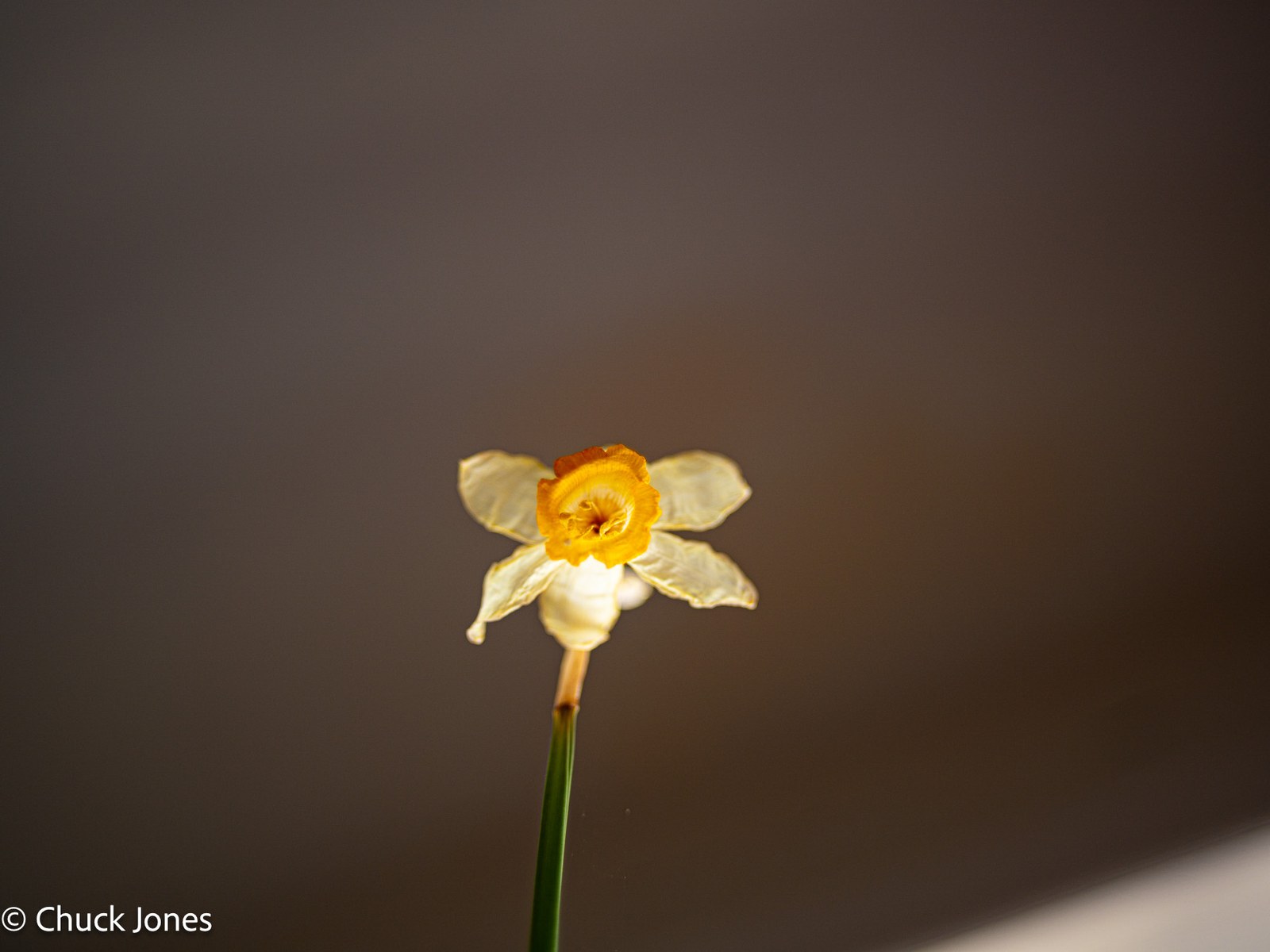
The first frame. Straight on, warm ambient light, the daffodil isolated against a smooth gradient background. Look at the petal veins. At f/2 on a 28mm wide angle, every vein in the corona is resolved. The transition from sharp petals to blurred background is not a hard wall. It is a slow, dimensional dissolve. That is the Distagon signature.
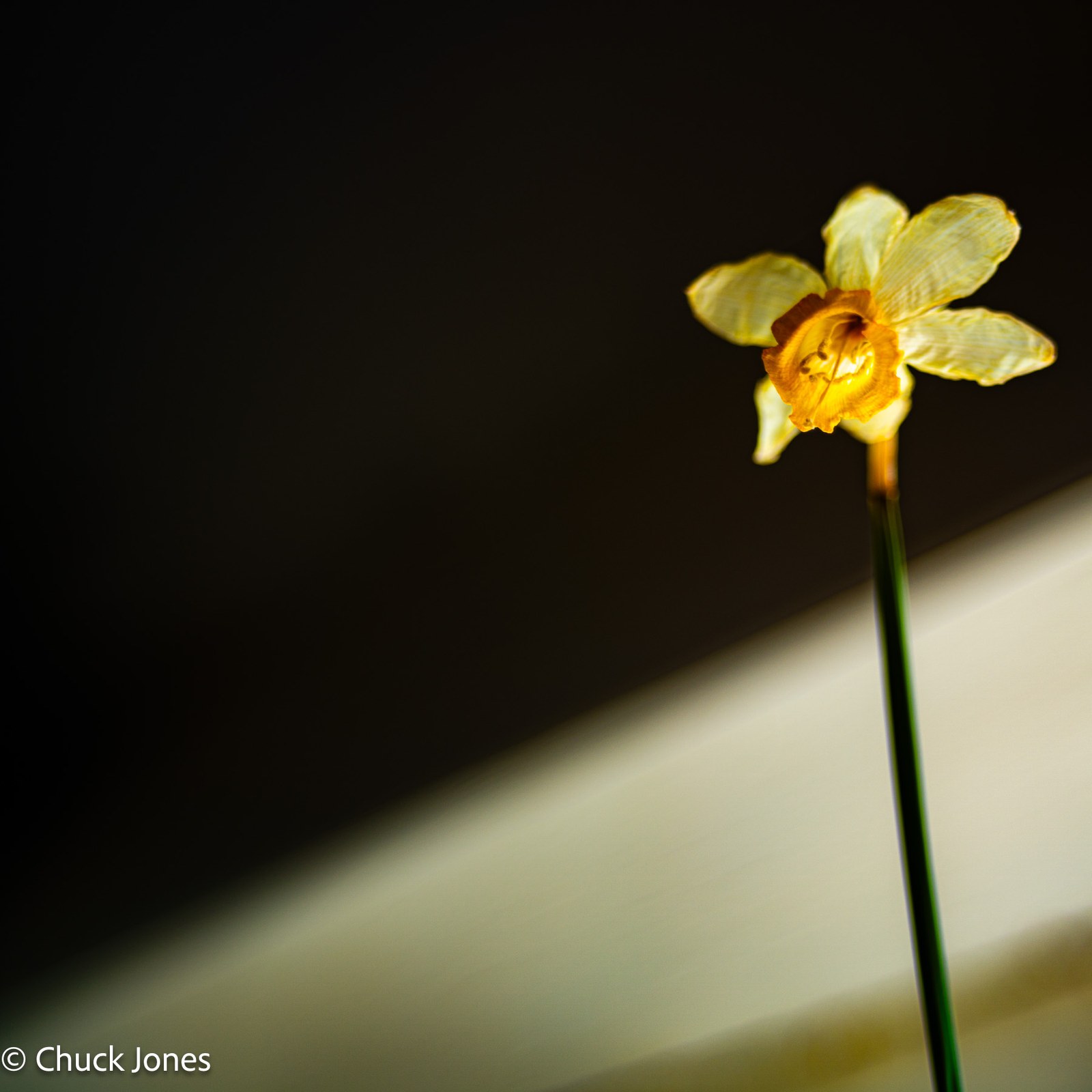
The second frame. Dark background, low angle, the flower glowing in warm sidelight. This is where “The Hollywood” earns its name. The way the light wraps around the corona, the way the stem holds its green against the darkness, the way the bokeh falls away to nothing. This is not what a modern 28mm lens does. Modern lenses resolve. This lens renders.
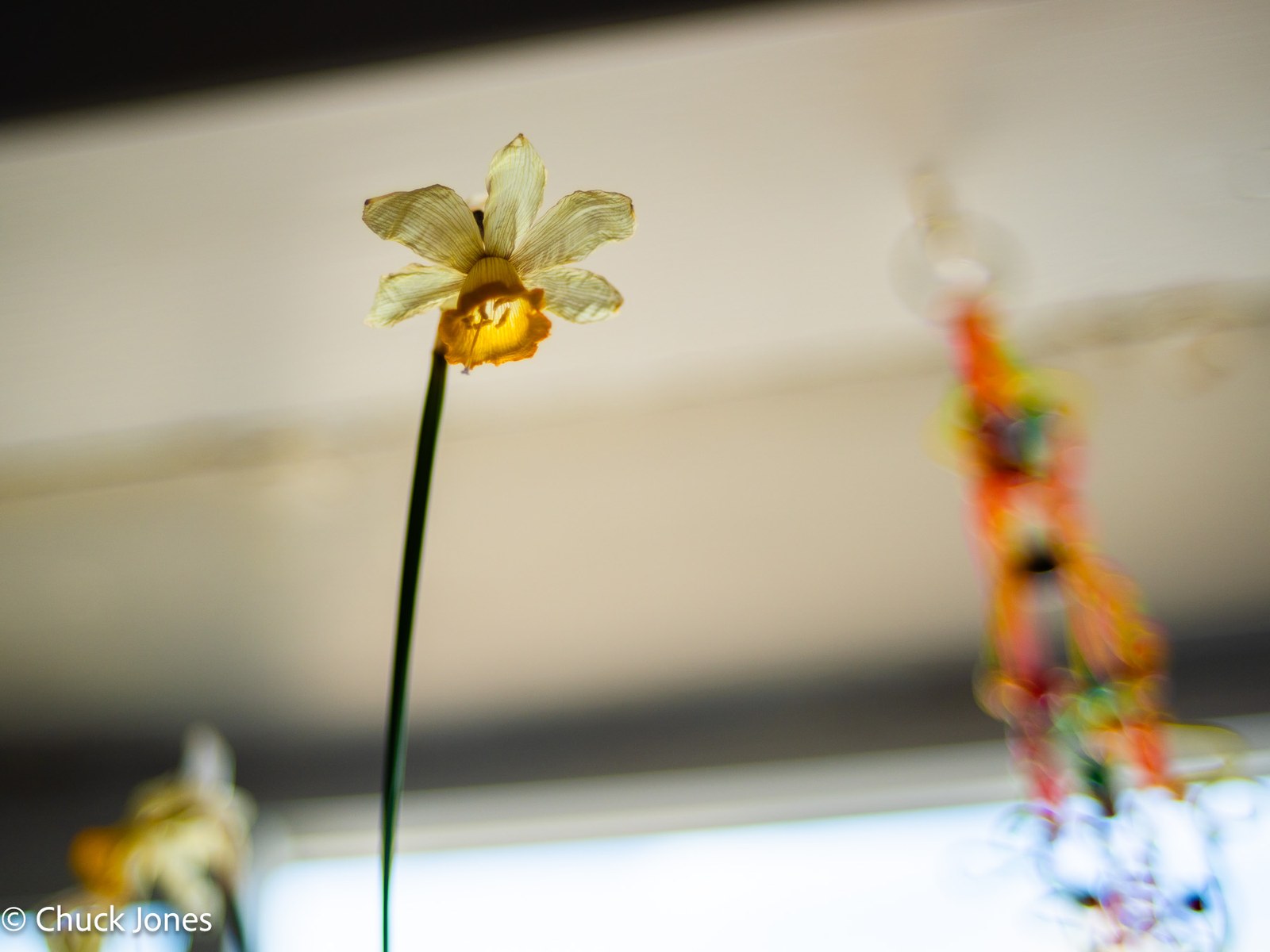
The third frame. Backlit against the ceiling with colored glass objects in the background dissolving into abstract shapes. This is a torture test for any lens. Bright backlighting, extreme contrast, specular highlights, and colored elements in the bokeh that will show every flaw in the optical formula.
The Distagon handles it. The petal detail in the backlit flower is maintained. The colored bokeh elements are smooth and organic, not harsh or nervous. There is no purple fringing. No hard edges in the out-of-focus areas. The lens is doing exactly what it was designed to do forty years ago, on a sensor that did not exist when the last copy left the factory.
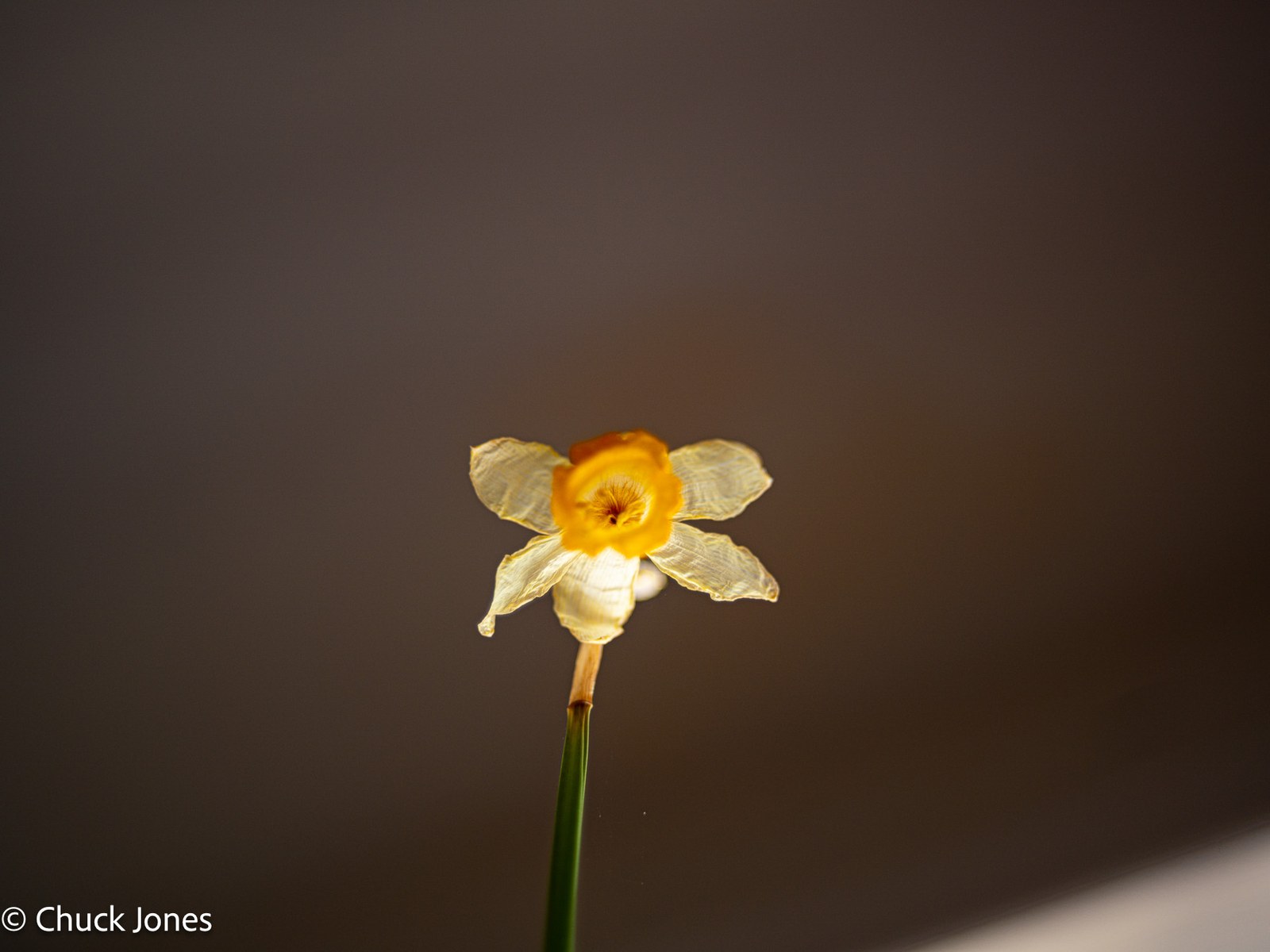
The fourth frame. Back to the warm background, slightly different angle, showing the full corona in sharp detail. Zoom in. The stamen is sharp. The inner trumpet texture is resolved. The petal edges show individual cellular structure.
At f/2. On a 28mm. On 61 megapixels.
Why This Lens Still Matters
The Contax Zeiss 28mm f/2 Distagon contains thorium oxide in its glass elements. Thorium is a rare earth element that is mildly radioactive. It is no longer legal to use in optical manufacturing. This means the specific rendering characteristics of this lens – the warmth, the contrast, the dimensional quality of its bokeh, the way it handles color in backlit situations – cannot be manufactured today. Not “difficult to manufacture.” Cannot.
Every copy that breaks, every copy that gets fungus, every copy that gets dropped is one fewer in existence. The total population of this lens only decreases. The price only goes up. And the images it produces remain unlike anything else you can mount on a camera.
I wrote about this lens eleven years ago on the Sony A7S. Twelve megapixels. I said it was a champion.
On 61 megapixels, it is still a champion. A single daffodil on my desk proves it.
The glass does not care what decade it is.
Find a Contax Zeiss 28mm f/2 Distagon at KEH Camera
Graded used copies with 180-day warranty.
Browse Contax Zeiss 28mm at KEH
TheCameraForum.com is an affiliate partner. We earn a small commission at no cost to you.
