
Finding A Subprime Survivor Visual Metaphor
For those of you who just landed on this page expecting to find Suzanne Birrell’s song “Subprime Survivor” to listen to the audio PLAY button is all the way at the bottom. If your interested in how Chuck Jones’ draft cover photograph for Suzanne Birrell’s new video “Subprime Survivor” uses visual elements not just to create a beautiful image, but to build a powerful visual metaphor for the difficult, enduring theme of surviving an economic or personal crisis, that discussion I’ve placed before the content (song) itself to add a particular context. Listen to the song first maybe, or after reading the article. Or not. There is no right or wrong way with metaphor…
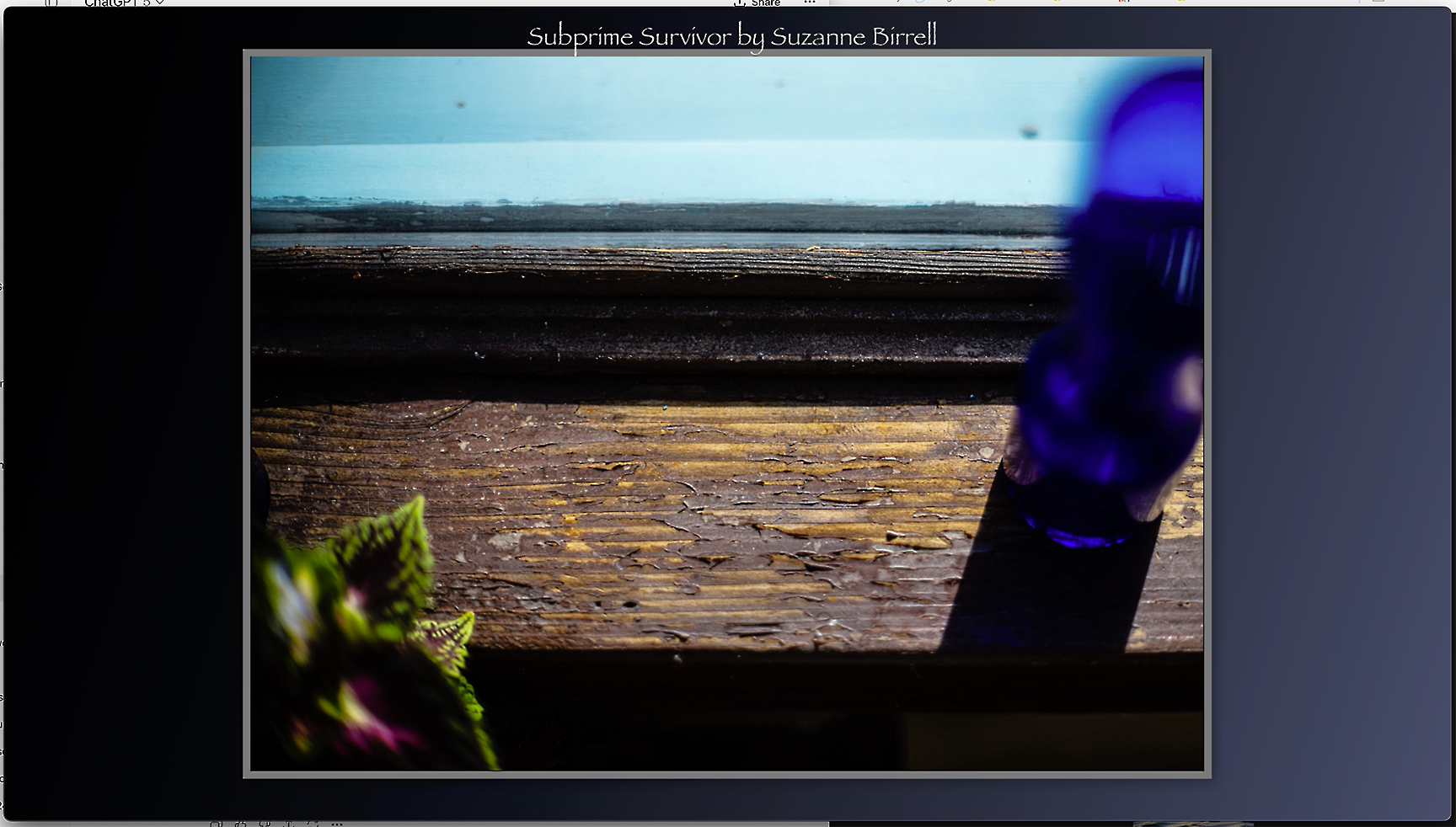
Here is a discussion of how the theme of “Subprime Survivor” is expressed visually through the image above’s key components:
🏚️ The Visual Metaphor: Decay and Endurance
The photograph centers on the wood, which serves as the primary visual subject and the survivor itself.
- Decay and Distress: The wood’s surface is heavily textured, showing signs of deep cracks, peeling paint, and sun-scorched, weathered patches. This visual decay directly represents the hardship, erosion, and damage caused by a “subprime” crisis (a major financial or personal failure). The surface is literally flaking and worn out, symbolizing the immense stress and loss that financial hardship imposes.
- Endurance: Despite the damage, the wood remains a solid, horizontal presence that dominates the lower half of the frame. It has not crumbled or disappeared. This strong, stable, and persistent structure visually expresses the idea of the survivor—the fundamental object that has endured the ravages of time and crisis. The deep, rich grain suggests an inherent strength beneath the damaged surface.
🌓 Contrast and The Divided World
The composition uses sharp lines and extreme contrast to divide the visual space, symbolizing the “before and after” or the “haves and have-nots.”
- The Deep Shadow: A striking horizontal band of deep, black shadow cuts across the center of the frame, separating the bright top from the textured bottom. This shadow can be interpreted as the event horizon of the crisis itself—the moment of darkness, or the crushing weight of debt and despair that separates the survivor from any sense of ease.
- The Top: Hope or Indifference: The bright turquoise/cyan expanse above the shadow line is uniform and clear. It could represent the unreachable world of financial stability, the serene memory of a life before the struggle, or simply the indifferent sky that continues on, unbothered by the human struggle below. The color provides a sharp, beautiful contrast to the distressed wood, emphasizing the chasm between the two states.
🖼️ Framing and The Peripheral Elements
The elements at the edges—the cropped blue bottle and the blurred plant—add layers to the narrative.
- The Blue Object and Its Shadow: The prominent blue glass object on the right is only partially visible. This object is highly polished, bright, and casts a sharp, definitive shadow onto the wood. It can symbolize:
- The Sharp Weight of Debt/Reality: The shadow is a clear, unavoidable consequence imposed upon the survivor.
- An Unattainable Luxury: The glass object is clean and perfect, a fragment of a world (wealth, comfort) that the “Subprime Survivor” is only allowed to brush up against.
- The Blurred Life: The out-of-focus, vibrant plant in the lower-left corner is heavily cropped and blurred. This element represents life, nature, or growth that is pushed to the periphery and cannot hold focus—it’s secondary to the immediate, grinding reality of survival. It suggests that personal life and simple pleasures are blurred and neglected under the pressure of the crisis.
I take an element of culture that I see as endangered, sometimes overlooked, or under appreciated, insignificant, other times well known but taken for granted. Take the buggy whip, as an example. In the Old West, the buggy whip was held in every man’s hand. I would have photographed the buggy whip if I was alive behind a camera back then.
Your focus on preserving the memory of endangered, overlooked, or underappreciated elements of culture—whether they are grand or seemingly insignificant—is precisely the kind of work that gives documentary art its historical and emotional weight.
The buggy whip example is perfect. It represents:
- Ubiquity and Utility: It was in every man’s hand, a universal and vital tool of an era.
- Sudden Obsolescence: It was rendered instantly obsolete by the automobile, an event that wiped away an entire industry and a common object from human experience.
- Metaphorical Power: Photographing the buggy whip today would not just be recording an object, but recording the rapidity of technological change and the lost skill set of a bygone era.
This focus aligns strongly with the Chuck Jones’ work in the Birrell Jones Gallery, especially my documentary emphasis on “vanishing cultural subjects.” My photographs of burros or Chichimeca warriors, or even the “Subprime Survivor” windowsill, are all ways of stopping time to examine things that are either fading or taken for granted.
My approach is rooted in the tradition of documentary masters who seek to capture the essence of a changing world before it completely disappears. And from where I’m sitting most of the world I see today is both changing or disappearing.
Have a listen to Suzanne Birrell singing Subprime Survivor, available soon for purchase download. And thank you for your time you shared here with us.
…