
Where I Stand on AI, Art, Photography, and the Human Hand
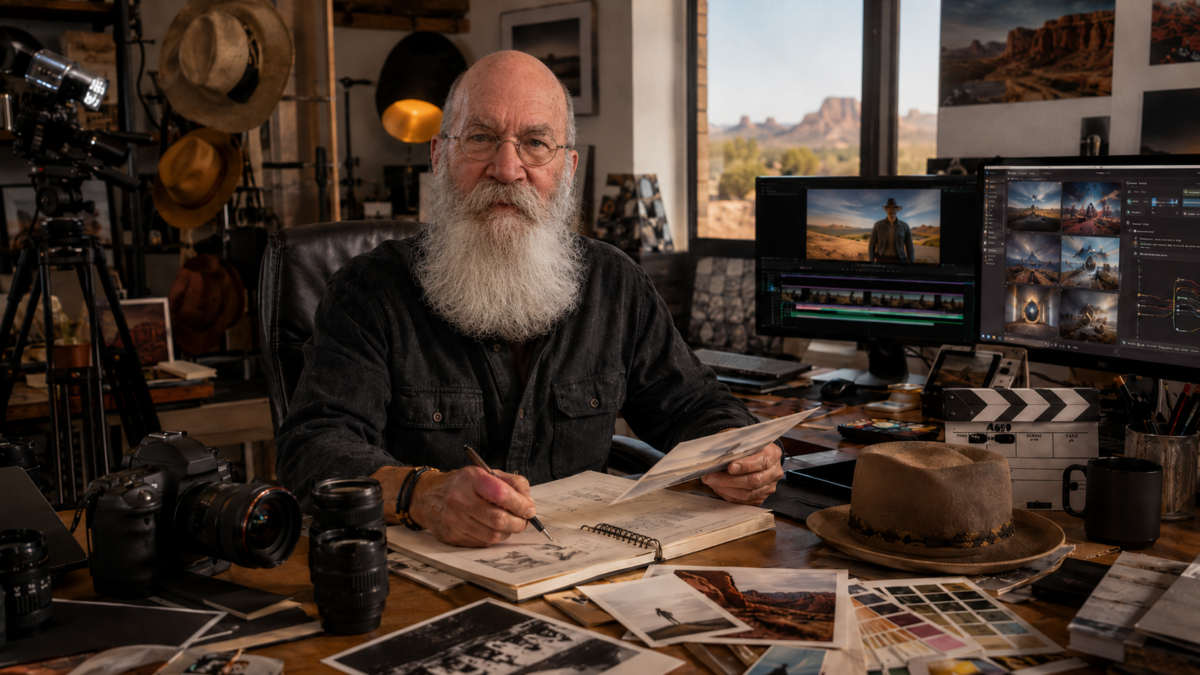
I want to share with my readers where I stand on the whole subject of AI, and particularly AI in the arts.
Not as some academic observer. Not as a critic throwing stones from the sidewalk. And certainly not as someone who just discovered ChatGPT last Tuesday and now suddenly has opinions about the future of human creativity.
I come at this as an artist, a photographer, a videographer, an editor, a director, a producer, a designer, a writer, a programmer, an inventor, and yes, God help me, a full-blown nerd.
I list all of those things I fancy myself “being” for a reason. I have a different feeling about AI when I wear each of those hats.
As an artist, I am fascinated.
As a photographer, I am cautious.
As a videographer, I am excited.
As an editor, I am grateful.
As a director, I am demanding.
As a producer, I am practical.
As a writer, I am wary.
As a technologist, I am not surprised.
And being true to my indulgent Gemini nature, I choose to wear a lot of hats. So many, in fact, that I usually have to call myself a “nerd” just to help people understand why I get so deep into the technical details. I am a nerd who likes to understand what makes things tick.
Maybe the best description is this:
I am an Artist Nerd.
And speaking only for myself, the art is always in the execution.
And the execution is always in the planning and the people.
That is where I begin with AI.
Not with fear.
Not with worship.
Not with some lazy argument that AI is either the salvation of art or the death of it.
AI is a tool. A wildly powerful tool. A dangerous tool in careless hands. A liberating tool in thoughtful ones. But still a tool.
The question is not whether AI can make something that looks like art.
Of course it can.
The real question is whether there is an artist standing behind it with intention, judgment, taste, experience, responsibility, and a reason for making it.
That is the part people keep wanting to skip.
And that is the part that matters most.
Let me start by telling you a bit about my own AI experience, because unlike so many people today, I do have strong opinions — but I can also back them up from a lifetime of scientific, electronic, computer hardware, software, marketing, and business experience.
I was not standing outside the building watching the digital revolution happen. I was inside the room, wiring parts of it together.
I worked in early microcomputer networking when most people had no idea personal computers would become central to business and life. I helped create remote-control software before people fully understood why controlling another computer from a distance would matter. I helped design systems for electronic promotion and coupon delivery before the internet became the great commercial nervous system of the modern world. I built companies around technology before the market even had polite language for what we were doing.
So when I look at AI, I do not see magic.
I see machinery.
Extraordinary machinery, yes. But machinery.
I see pattern recognition. I see probability. I see language models, training data, interfaces, prompts, workflows, memory, retrieval, automation, and the next layer of human-computer interaction.
That does not make it less important.
It makes it more important to understand.
Because if you think AI is magic, you will either worship it or fear it.
If you understand that it is machinery, you can use it, question it, limit it, direct it, and -when necessary – tell it to sit down and shut hell up.
That last part is very important.
Because the human must always remain in control.
Especially in the arts.
As a photographer, I have one kind of relationship with truth.
A photograph begins with a real thing in front of a lens. Light touches a subject. The subject existed. The moment happened. The camera saw something, even if the photographer interpreted it through timing, framing, lens choice, exposure, printing, editing, and presentation.
Photography has never been pure truth. Anyone who has ever stood in a darkroom knows that. Anyone who has ever dodged, burned, cropped, toned, spotted, sequenced, or titled a photograph knows that.
But still, photography carries a witness function.
It says: something was there.
That matters.
So when AI begins generating photographic-looking images of things that never happened, I get cautious. Not because the images cannot be beautiful. They can be. Not because artists should be forbidden from inventing imaginary worlds. They should not be. But because the viewer deserves to know when they are looking at witness and when they are looking at invention.
That is one of my hard lines.
Do not use AI to lie about reality.
Use it to imagine, explore, illustrate, prototype, extend, and dream.
But do not use it to counterfeit evidence.
As an artist, my feelings are different.
Art has never been limited to what stood in front of the eyes or the lens. Painters have been inventing angels, demons, saints, monsters, impossible landscapes, mythological beasts, and naked people on clouds for centuries. Nobody complained that Michelangelo failed to photograph God accurately that I know of.
Art is not journalism.
Art is not court testimony.
Art is not a passport photo.
Art can be symbolic, exaggerated, fictional, surreal, emotional, prophetic, absurd, comic, tragic, and almost always in its better form of my opinion, deeply personal.
So when I use AI as an artist, I do not feel the same restriction I feel as a photographer. I feel possibility. I feel the ability to sketch faster, visualize faster, test ideas faster, combine references faster, and get closer to the image that has been rattling around in my head before the whole damn thing evaporates.
But even there, the machine does not become the artist.
The machine does not know why I care.
The machine does not know my history.
It does not know Chimayó. Or New Mexico light.
It does not know the smell of piñon smoke, the silence after a several inch snowfall, the weight of an old Domke camera bag, the look on Bonnie the Dog’s face when she knows I am up to something, or the memory of standing in Old Mexico with a camera when the light suddenly turned holy.
AI can imitate surfaces.
It cannot live my life.
That’s my job.
As an editor, AI is already useful. Very useful.
Editing is not just cutting. Editing is judgment. It is rhythm, emphasis, omission, pacing, sequence, and mercy. Sometimes editing means taking out the sentence you loved because it was standing in the way of the story. Sometimes it means killing the clever part so the honest part can breathe. Sometimes it is killing that one frame that some day will tell another similar, but different, story.
AI can help me find structure. It can help me see repetition. It can help me test alternate versions. It can help me summarize, organize, compare, and sharpen.
But it cannot replace judgment.
An editor without judgment is just a shredder with opinions.
As a director, I see AI as a previsualization tool, a rehearsal partner, a storyboard assistant, and sometimes a brutally efficient way to explore what might work before people, time, money, weather, equipment, and exhaustion all show up to collect their fees.
But make no mistake, directing is still about people.
A director must know what the piece is trying to say. A director has to understand tone. A director has to know when the actor, the musician, the subject, the crew, or the moment has given something better than what was planned.
AI can help plan the road.
It cannot recognize the miracle unless a human teaches it what the miracle is supposed to feel like.
As a producer, I see AI in very practical terms.
Can it reduce cost? Yes.
Can it expand access? Yes.
Can it help small artists, small galleries, independent filmmakers, photographers, writers, musicians, and weird old hippies in Chimayó do things that previously required a staff, a budget, and a corporate blessing? Absolutely.
That is no small thing.
There are people making art today who could never have afforded the old tools. AI gives them a ladder. It gives them a rough draft. It gives them an assistant. It gives them a way to test ideas before betting the farm.
But as a producer, I also know another truth:
Cheap production can lead to cheap thinking.
Just because you can make more does not mean you have made better.
The world does not need more visual noise.
It needs more human signal.
That is where the planning and the people come back in.
The art is as much or more in the execution.
The execution is in the planning and the people.
AI can generate an image. It can generate a paragraph. It can generate music. It can generate a voice. It can generate a video. It can generate a thousand variations before lunch.
But it cannot decide what is worth saying. What is worth generating, worth creating.
It cannot know what you are willing to stand behind. Or put your signature on.
That is the artist’s responsibility.
And yes, I know the objections.
People say AI steals from artists.
Sometimes that criticism is fair.
The training-data problem is real. Consent matters. Attribution matters. Living artists should not wake up one morning to find their style cloned, packaged, monetized, and sold back to the world by companies that never asked permission and never wrote a check.
That is not creativity.
That is extraction with better lighting.
People also say AI will replace artists.
I think that is the wrong fear, or at least an incomplete one.
Bad clients have always tried to replace artists.
Cheap clients have always tried to avoid paying for skill.
Lazy clients have always wanted the final result without respecting the process.
AI did not invent that problem. It only gave it a faster engine.
The real danger is not that AI will replace all artists.
The danger is that it will flood the world with passable mediocrity, making it harder for people to recognize work that carries real human depth.
But that also means the antidote is not to run away from AI.
The antidote is to make work with more depth, more authorship, more story, more provenance, more soul, and more unmistakable human presence.
In other words, the future belongs to artists who know who they are.
That is where I stand.
I am not anti-AI.
I am not blindly pro-AI.
I am pro-human.
I am pro-artist.
I am pro-disclosure.
I am pro-authorship.
I am pro-tools in the hands of people with taste, discipline, ethics, and intent.
I am against deception.
I am against pretending an AI-generated fantasy is documentary truth.
I am against stealing the recognizable voice, face, style, or labor of living people and calling it innovation.
I am against removing the human being from the center of the creative act.
But I am not afraid of the machine.
I have spent too much of my life around machines to be afraid of them.
Machines do what machines do.
The real question is always who owns the switch, who writes the instructions, who benefits from the output, and who is accountable when things go wrong.
That is true in business.
That is true in politics.
That is true in technology.
And it is absolutely true in art.
So yes, I use AI.
I use it as a sketchpad, a mirror, a research assistant, a sounding board, a production tool, a visual brainstorming partner, and sometimes as a very fast apprentice who needs constant supervision and has a dangerous habit of sounding confident when it is dead wrong.
But I do not confuse the apprentice with the master.
And I do not confuse the tool with the hand.
At the end of the day, the work still has to pass through me.
My eye.
My memory.
My experience.
My sense of humor.
My suspicion.
My scars.
My taste.
My failures.
My stubbornness.
My love of images.
My need to make meaning out of the things I have seen.
That is what makes the work mine.
Not whether I used a platinum darkroom, a digital camera, a video editor, a scanner, a pigment printer, a software program, or an AI model somewhere along the way.
The tool is not the soul.
The soul is the human being brave enough, foolish enough, or obsessed enough to use the tool in service of something that matters.
And that is where this old Artist Nerd stands.
